
FLY RC Cellmeter 7
4.6Editor score
Lightweight and compact design
Displays total and cell voltage
Supports NiCd and NiMH packs
This guide compares the top Li Ion Battery Tester models to help you find the best device for checking capacity, voltage, and health across various battery
Finding the right tool to check your rechargeable cells is essential for safety and performance. A good Li Ion Battery Tester provides accurate voltage and capacity readings without damaging the pack. We evaluated the latest options to help you choose wisely.
Our comparison covers devices ranging from simple voltage checkers to advanced capacity analyzers with balancing features. Each product was selected based on compatibility, accuracy, ease of use, and user feedback from reliable sources. This list helps you match a tool to your specific needs.
Each pick highlights key strengths, weaknesses, and ideal use cases for different battery types like 18650, LiPo, and standard alkalines. Please note that prices and availability change frequently, so verify current details before purchasing to ensure you get the best value today.
4.6Editor score

4.7Editor score

4.5Editor score
The following table provides a side-by-side comparison of all ten selected Li Ion Battery Tester models. It highlights key specifications, compatibility, and unique features to help you quickly identify the right tool for your battery maintenance needs.




This module offers a straightforward way to test 18650 batteries with capacity and internal resistance metrics. It holds a solid 4.3 rating and stands out for providing four channels in a small footprint.
We may earn a commission when you buy through this link, at no additional cost to you.
The integration of charge and discharge functions simplifies the workflow for users checking multiple cells at once. The screen displays voltage, current, power, and battery level simultaneously for comprehensive analysis during testing.
One trade-off is the initial need to request the manual from the seller, which can delay setup. Additionally, the measurement error is noted at around 10%, so it is best for general checks rather than precision labs.
This tool is ideal for hobbyists needing a quick way to verify cell health without a full charger setup. It delivers essential data for replacing batteries in equipment efficiently.
Testing four batteries at once saves time and effort for anyone managing larger batches of cells.
Seeing voltage, current, and power live helps you spot issues immediately during the test cycle.
We may earn a commission when you buy through this link, at no additional cost to you.
The Magnetic Battery Tester is designed for household convenience, supporting a wide range of common battery types including Li-ion. It earns a 4.5 rating and features a magnetic slot that secures batteries for single-hand testing.
We may earn a commission when you buy through this link, at no additional cost to you.
Its LCD display clearly indicates voltage and health status, making it easy to know if a battery is good, weak, or poor. The unit is rechargeable via USB-C and lasts up to fifteen hours on a full charge.
While the design is user-friendly, you must purchase a separate power adapter for the USB-C input, which is not in the box. The buzzer also requires a specific double-press action to toggle on or off, which might take learning.
This tester is perfect for home users who need a reliable way to check AA, AAA, and lithium batteries quickly. The magnetic feature ensures you do not slip or drop cells during evaluation.
The magnetic slider holds the battery firmly so you can test with just one hand easily.
A single charge lasts up to fifteen hours, reducing the need for frequent recharging or battery swaps.
We may earn a commission when you buy through this link, at no additional cost to you.
The RC Cellmeter 8 provides precise voltage testing for various battery types and holds a 4.4 rating among users. It features a large LCD screen and a simple one-click button for easy operation even by beginners.
We may earn a commission when you buy through this link, at no additional cost to you.
This device is essential for RC enthusiasts who need to monitor LiPo, Li-ion, NiMH, and Nicd cells quickly. The minimum operating voltage of 1.2 volts helps prevent damage to your devices and batteries during checks.
Although it excels at voltage checks, it does not measure capacity, which limits its use for full health analysis. However, for quick field checks before flying or driving, it remains a reliable and safe option.
Buy this if you need a lightweight tool to ensure your RC packs are charged and balanced enough for safe use. The user-friendly design makes it a standard choice in hobby boxes.
The one-click measurement button and large screen make it easy for anyone to check voltage quickly.
With a minimum operating voltage of 1.2 volts, it helps avoid drawing too much power from weak cells.
We may earn a commission when you buy through this link, at no additional cost to you.
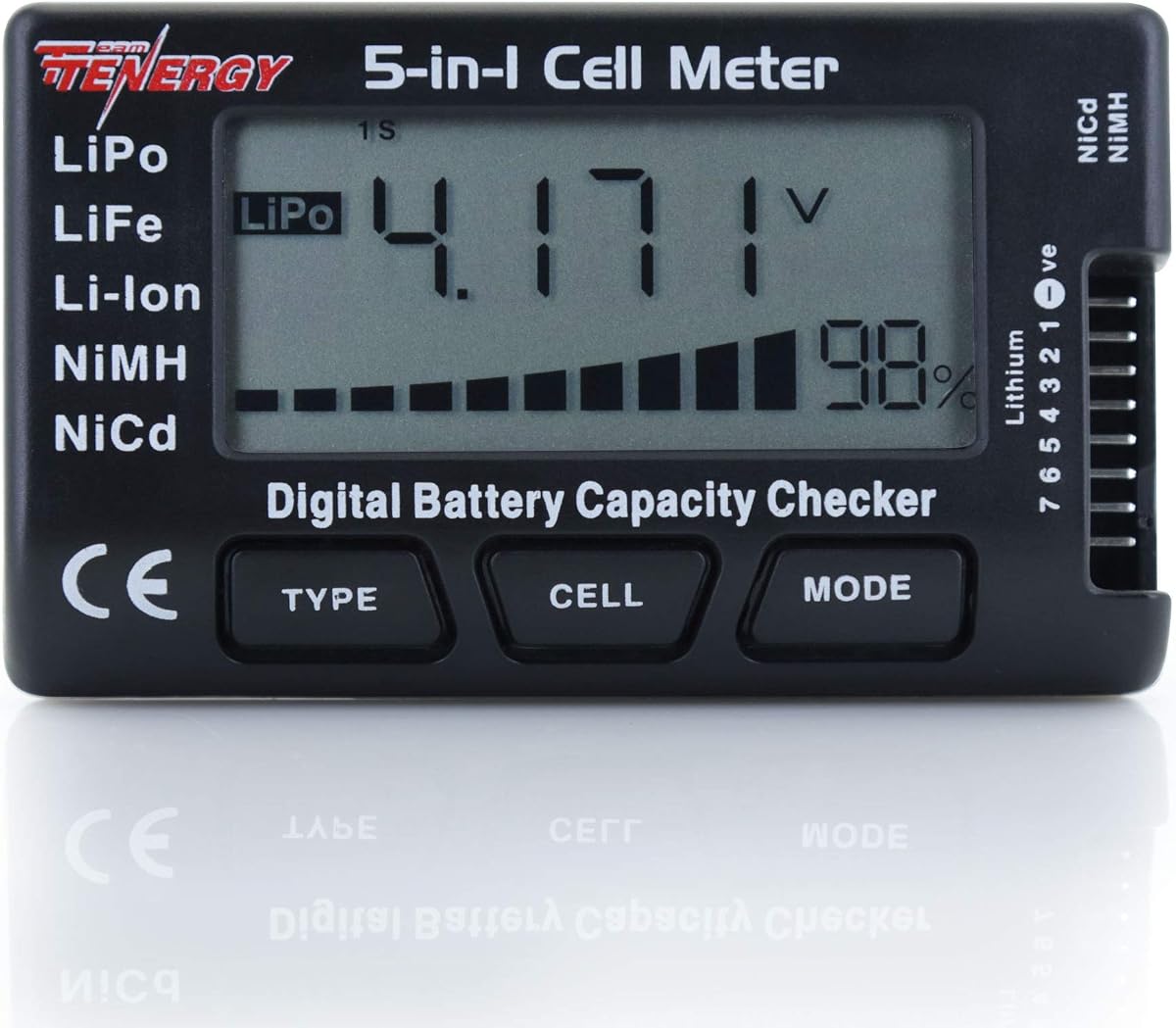
This Tenergy meter stands out by combining voltage checking with a balancer function, earning a 4.6 rating from users. It powers itself from the battery pack being tested, requiring no additional accessories for immediate use.
We may earn a commission when you buy through this link, at no additional cost to you.
The device helps optimize battery performance and extend lifespan by ensuring individual cells are balanced. It also discharges packs to an adjustable threshold at 180mA, which can improve runtime before the next charge.
While useful, it requires compatible balance connectors for lithium packs and does not power on unless connected to a valid pack. This dependency means you must have the right connectors handy before starting any test.
It is a strong choice for users who want to maintain pack health beyond just checking voltage. The built-in internal resistance tester also helps decide when to discard or replace old batteries safely.
Balancing individual cells helps the pack run longer and last more charge cycles overall.
The 180mA discharge rate allows you to safely lower battery voltage to a target threshold.
We may earn a commission when you buy through this link, at no additional cost to you.
The FLY RC Cellmeter 7 is a lightweight and compact tool that holds a 4.6 rating. It shows detailed voltage modes including lowest, highest, and the gap between them for better pack analysis.
We may earn a commission when you buy through this link, at no additional cost to you.
It applies to LiPo, LiFe, Li-ion, NiMH, and Nicd batteries and displays remaining battery capacity percentage for a clear health overview. Its durability and excellent performance make it a reliable daily driver for hobbyists.
The main trade-off is that it lacks advanced connectivity or balancing features found in higher-end meters. However, for its low price, it offers essential data without unnecessary complexity or bulk.
Choose this if you want a simple, cost-effective way to check your RC packs quickly. It fits easily in a tool bag and provides immediate readings for flight or drive readiness.
Seeing the difference between highest and lowest cell voltage helps you spot weak cells in a pack.
The display shows remaining battery capacity percent so you know how much life is left.
We may earn a commission when you buy through this link, at no additional cost to you.
The ISDT BG-8S Lipo Battery Checker offers smart features through BattGO technology when connected with XT60i. It holds a 4.4 rating and allows detailed parameter views including cell voltage, cycles, and working settings.
We may earn a commission when you buy through this link, at no additional cost to you.
Its auto balancing algorithm ensures every cell is well balanced before entering low power mode. It also acts as a power bank for mobile devices and RC gear, supporting Qualcomm QC 2.0 and 3.0 standards.
To get the full benefit of BattGO, you need the specific XT60i connector, which may not be included. The device is also pricier than basic checkers, but the extra functionality justifies the cost for many.
This checker is great for users who want to monitor battery health deeply while having a backup power source. The versatility in connections makes it adaptable to many different battery setups.
Connecting with XT60i unlocks detailed parameters like cycles and specific working settings.
It supports many connectors like XT60, XH, and JST for wide compatibility across packs.
We may earn a commission when you buy through this link, at no additional cost to you.
The ISDT BG-8S Battery Meter earns a 4.7 rating and serves as a robust tool for modern RC and battery users. It works with BattGO technology to provide detailed parameter readouts and easy setting adjustments.
We may earn a commission when you buy through this link, at no additional cost to you.
It supports receiver signal tests and multi-protocol analysis like PWM and PPM, adding value beyond simple voltage checks. The device also outputs up to 12V and 2A for portable charging needs on the go.
While it is a premium option with a higher price, the protocol analysis and signal testing make it a standout choice. The advanced matching algorithm ensures each cell stays balanced for longer pack life.
This meter is the top pick for tech-savvy users who need more than just a voltage readout. Its ability to test receiver signals and charge other devices makes it a versatile asset in the field.
Multi-protocol analysis helps diagnose receiver issues without needing separate equipment.
Maximum output of 12V and 2A allows it to charge mobile devices effectively as a backup.
We may earn a commission when you buy through this link, at no additional cost to you.
This Advanced 8 Channel Battery Tester is designed for labs, workshops, or homes needing serious analysis of 18650 cells. It features eight independent channels for simultaneous operations without interference and holds a 4.5 rating.
We may earn a commission when you buy through this link, at no additional cost to you.
The 2.4 inch color screen shows real-time data for charge or discharge cycles and internal resistance. It includes reverse connection protection and active heat dissipation systems to ensure safety during use.
While no rating is listed, the features suggest a professional-grade device capable of handling complex battery tasks. The ability to test and charge automatically makes it a heavy-duty option for enthusiasts and pros.
Choose this if you need a premium solution for capacity measurement and detailed resistance checks. It brings professional capabilities to a portable form factor with modern safety and display features.
Eight independent channels let you run multiple tests at once without slowing down the process.
Reverse connection protection and active heat dissipation keep the device and your batteries safe.
We may earn a commission when you buy through this link, at no additional cost to you.
The QWORK RC Battery Capacity Checker holds a high 4.7 rating and focuses on clear voltage information for drone and RC users. It supports 2 to 7S packs and shows total, per-cell, and max/min voltage details instantly.
We may earn a commission when you buy through this link, at no additional cost to you.
Its digital screen gives immediate readings of cell condition which helps you decide if a pack is safe to fly. The compact design makes it easy to carry for quick field checking on drones, cars, and aircraft.
It only works with balance connectors and does not test single cells or charge batteries, so it is a focused tool. This limitation keeps the price low and the device lightweight for mobile use in the field.
Buy this if you fly drones or RC vehicles and need a simple voltage check before each session. It provides exactly what you need for a safety check without extra bulk or features.
The digital screen provides instant reading of cell condition for fast pre-flight checks.
Lightweight design ensures you can easily carry it for quick checks in the field.
We may earn a commission when you buy through this link, at no additional cost to you.
The ZTS Mini Multi-Battery Load Tester uses patented Pulse Load Technology to measure battery life under load for accurate results. It is fully automatic and holds a 4.5 rating for identifying weak or failing household batteries.
We may earn a commission when you buy through this link, at no additional cost to you.
With no switches or settings, the two-second test identifies which 1.5V, 1.2V, 3.6V, 3V, or 9V batteries are still good. Its compact design makes it easy to pack and travel with, storing probes in the seam.
The main limitation is that it focuses on standard household battery types and may not be suited for advanced lithium packs. However, for home use, it is highly reliable and saves money by testing remaining capacity.
This tool is perfect for keeping an eye on all the batteries in your home to decide when to recycle them. It offers high accuracy and a one-year warranty to back its claims of reliability.
Pulse Load Technology measures battery life under load rather than just a simple voltage readout.
No switches or settings are needed, as the test runs automatically in just two seconds.
We may earn a commission when you buy through this link, at no additional cost to you.
Selecting the right Li Ion Battery Tester depends on your specific needs, such as testing household cells or advanced RC packs. This guide outlines key factors to consider before making your purchase.
Ensure the device supports the types and sizes of batteries you use most. Some testers focus on 18650 cells while others handle AA, AAA, or balance connectors for RC packs.
Check the compatibility list to avoid buying a tool that does not work with your primary battery types.
Look for testers that measure more than just voltage if you need health checks. Capacity measurement and internal resistance testing provide deeper insights into battery condition.
Prioritize devices that offer capacity and resistance data if you manage large packs or critical batteries.
Consider how intuitive the interface is for your skill level. Buttons, displays, and menu structures should allow you to get readings without complex setup or manuals.
Choose a model with clear displays and minimal steps if you want quick and reliable results.
Some testers require their own battery while others are powered by the test pack. Rechargeable internal batteries offer convenience but add to the weight and initial cost.
Select a power source that matches your usage pattern to ensure you never run out of power during a test.
A durable tester should withstand drops and handling in a workshop or field environment. Materials and design impact how long the tool will last under regular use.
Invest in a sturdy build to avoid frequent replacements and ensure consistent performance over time.
The screen should show all relevant data like voltage, current, and health clearly. Larger displays help you read results in different lighting conditions.
Look for a display that provides real-time or clear static data for quick decision making.
Prices vary widely based on features and brand. A basic checker may suffice for home batteries while advanced models justify their cost for hobbyists.
Balance the cost against the features you need to ensure you get the best value for your situation.
Before testing, ensure your battery terminals are clean and dry. Insert or connect the battery according to the device instructions, making sure positive and negative contacts align correctly to prevent short circuits.
Turn on the device and select the correct battery type if required. Wait for the reading to stabilize before recording the values to ensure accuracy. Some testers may display health status or capacity percentages automatically.
After use, store the tester in a dry and protected place. If the device has an internal battery, recharge it periodically to maintain its lifespan. Keep the contacts on the tester clean to ensure reliable connections for future tests.
Most modern testers cover Li-ion, LiPo, NiMH, and NiCd cells. Some models also support standard alkaline types like AA, AAA, or 9V for household use. Always verify compatibility with your specific battery types.
A tester shows voltage, capacity, or health status. If the voltage is significantly lower than expected or the capacity is low, the battery may be failing. Internal resistance spikes also indicate a worn out cell.
Some advanced models include charge and discharge functions to restore battery performance. Basic checkers only measure voltage and health. Always check the features list to confirm if charging is supported.
Yes, most testers are designed with safety features like reverse polarity protection. They draw limited current during testing to avoid damaging the battery or causing a short circuit. Follow the manufacturer guidelines for safety.
Test batteries every few months or whenever you plan to use them after long storage. Regular checks help identify weak cells before they fail during critical use. This extends overall battery life.
Many universal testers support AA and AAA batteries. However, some specialized Li-ion testers focus only on high voltage lithium cells. Check the device specs to confirm it handles standard 1.5V or 1.2V types.
The top picks for the best Li Ion Battery Tester range from the budget-friendly FLY RC Cellmeter 7 to the premium ISDT BG-8S Battery Meter. Each model serves different needs whether you are managing household cells or complex RC packs.
When prioritizing your purchase consider compatibility with your battery types and the features that matter most such as capacity measurement or safety checks. A clear display and ease of use also enhance the daily experience.
Prices and availability for these devices change frequently so verify current details before purchasing to ensure you get the best value. We hope this guide helps you find the perfect tool for safe and efficient battery management.