
QNAP TL-D1600S
4.5Editor score
SATA 6Gbps JBOD
PCIe card included
Desktop expansion
Compare the top 16 Bay NAS enclosures for performance and capacity. This guide reviews features specs and reliability of leading models for 2026 storage needs.
Finding the right storage solution for your growing data needs is crucial in today digital landscape. A 16 bay NAS enclosure offers massive capacity and flexibility for businesses and enthusiasts alike who need reliable access to large files.
We have evaluated ten distinct models ranging from budget friendly DAS units to enterprise grade rackmount systems. Our analysis focuses on drive compatibility expansion options networking capabilities and overall build quality to ensure you find the perfect fit.
Each selection below highlights unique strengths whether you need hot swappable bays redundant power or high speed interfaces. Keep in mind that specific configurations and availability may change so always verify details before making your final purchase decision.
4.5Editor score

This side-by-side comparison highlights the key specifications and capabilities of each enclosure to help you quickly identify which model aligns with your specific storage architecture and performance requirements.


The CENMATE Aluminum 12 Bay provides a robust external storage solution for those needing quick access to multiple drives without complex RAID configurations. With a rating of 4.3 stars users appreciate its straightforward plug and play design and reliable performance across different operating systems.
We may earn a commission when you buy through this link, at no additional cost to you.
Its aluminum construction paired with three cooling fans ensures that drives remain at safe temperatures during heavy use. The USB 3.0 interface delivers transfer speeds significantly faster than older standards allowing you to move large files quickly without bottlenecking your workflow.
However buyers should be aware that the fans can generate noticeable noise which might not suit quiet environments. Additionally the manual advises testing drives individually to ensure proper detection which adds a step to the initial setup process.
This unit is ideal for media editors or IT professionals who need a simple reliable DAS enclosure for backup or content storage. If you value durability and speed over silent operation this is a strong contender for your desktop setup.
Utilizing USB 3.0 technology this enclosure allows transfers up to ten times faster than USB 2.0 ensuring efficient workflow for large media files.
Three dedicated fans work to dissipate heat from the drives maintaining optimal operating temperatures during extended usage sessions.
We may earn a commission when you buy through this link, at no additional cost to you.
The Synology 16 bay RackStation represents the pinnacle of network attached storage performance designed for businesses that require relentless uptime and massive throughput. While the price point is significant the hardware capabilities justify the cost for mission critical applications.
We may earn a commission when you buy through this link, at no additional cost to you.
Equipped with an eight core processor and dual redundant power supplies this unit handles virtualization and heavy file serving with ease. The PCIe slots allow further customization through network cards or cache adapters tailoring the system to specific bandwidth needs.
The main drawback is the complexity and cost which may be overkill for home users or small setups. It demands technical knowledge to configure optimally but once set up it offers exceptional stability and expansion potential.
Organizations seeking a central storage hub capable of scaling up to forty bays will find this model indispensable. Its robust build and support options ensure that your data remains secure and accessible around the clock.
Supports expansion to forty drive bays using additional units allowing businesses to grow storage capacity seamlessly as needs evolve.
Dual redundant power supplies ensure that the system remains operational even if one power unit fails minimizing downtime risks.
We may earn a commission when you buy through this link, at no additional cost to you.
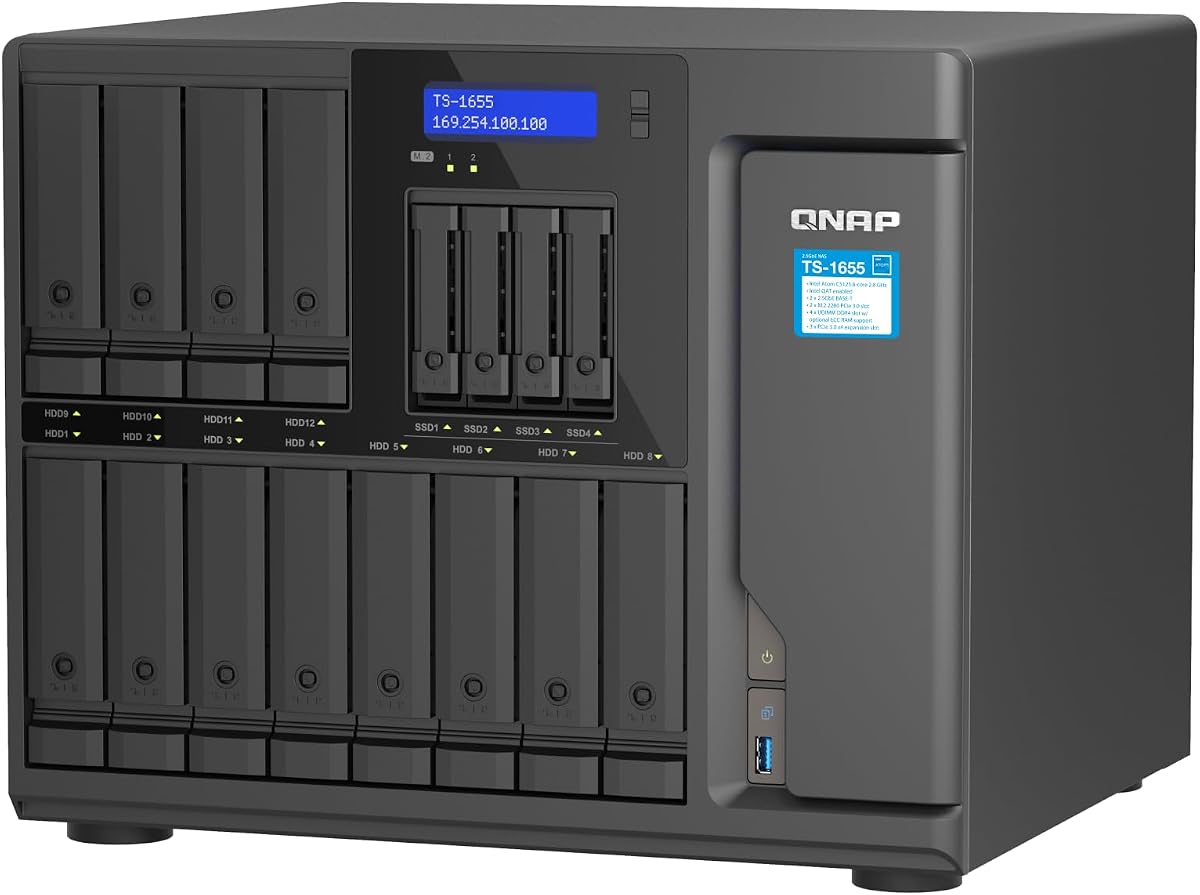
The QNAP TS-1655-8G-US stands out as a versatile hybrid NAS combining high capacity with performance features suited for modern workloads. Its eight core Atom processor provides ample power for virtualization and media processing without breaking the bank.
We may earn a commission when you buy through this link, at no additional cost to you.
With dual 2.5GbE ports and support for NVMe caching this unit accelerates file access and application performance significantly. The ability to upgrade RAM to 128GB ensures it can handle demanding multitasking scenarios smoothly.
Users might need to add memory to reach full potential which adds to the setup time and cost. The interface is feature rich but can be overwhelming for those new to NAS administration requiring some initial study.
This model is perfect for power users who want a balance of speed and storage in one unit. It excels in environments where quick access to large datasets is critical for productivity and efficiency.
Dual M.2 NVMe slots allow for SSD caching or storage pools dramatically boosting read and write speeds for applications.
Dual 2.5GbE network ports provide high bandwidth for large file transfers and virtualized environments efficiently.
We may earn a commission when you buy through this link, at no additional cost to you.
The Synology 12 Bay Disk Expansion DX1222 is a specialized unit designed to extend the capabilities of compatible Synology diskstation units. With a rating of 4.7 stars it is highly regarded for its simplicity and reliability in expanding storage pools.
We may earn a commission when you buy through this link, at no additional cost to you.
Configuring new storage takes only minutes thanks to Synology DSM unified management tools which streamline the entire process. This unit maintains the consistent interface users are familiar with ensuring that added drives behave exactly like internal ones.
However it is only compatible with specific Synology models which limits its utility for those with other brands. The cost is an added expense but the seamless operation and five year warranty provide peace of mind for long term storage.
This expansion unit is best for existing Synology users needing more space without changing their primary system. It ensures that your data grows effortlessly within the same secure and manageable ecosystem.
DSM software integrates new drives automatically allowing you to configure expansion in minutes without technical hassle.
The standard five year warranty ensures that your expansion hardware is protected against defects for a long period.
We may earn a commission when you buy through this link, at no additional cost to you.
The Generic ZhenLoong Full Tower case offers a blank slate for building a custom NAS or workstation with support for up to fifteen hot swappable drives. Its flexible motherboard support and GPU capability make it a unique choice for advanced builders.
We may earn a commission when you buy through this link, at no additional cost to you.
The chassis is built from sturdy SGCC steel and supports ATX or redundant power supplies ensuring physical robustness. With eight full height expansion slots you can add specialized cards like NVMe controllers or network accelerators as needed.
Shipping takes approximately thirty to forty days by sea which requires patience from buyers. Additionally assembly can be complex due to the large size and weight so having a clear plan is essential for setup.
This case is perfect for enthusiasts who want total control over their NAS hardware and form factor. If you need a custom solution that fits your specific performance and cooling requirements this chassis is an excellent base.
Supports multiple motherboard sizes and full height slots allowing you to tailor the system to your exact needs.
Five hot swappable drive bays allow you to replace drives without shutting down the system ensuring continuous operation.
We may earn a commission when you buy through this link, at no additional cost to you.
The Asustor Lockerstor 10 Gen3 pushes performance boundaries with an AMD Ryzen processor and DDR5 memory designed for demanding workloads. Its network capabilities are particularly impressive featuring dual 10GbE ports for ultra high bandwidth data transfer.
We may earn a commission when you buy through this link, at no additional cost to you.
The inclusion of USB4 40Gbps ports allows for incredibly fast external storage connections which is rare in this category. ECC memory ensures data integrity during intensive tasks like virtualization and database hosting providing enterprise level stability.
While it only supports ten drives rather than sixteen it makes up for it with sheer speed and feature density. The price point is high but justified for professionals who need every bit of performance available for their workflows.
This NAS is ideal for creative studios or IT departments handling large files and heavy traffic. If your priority is speed and future proof connectivity over maximum drive count this model delivers outstanding results.
Dual 10GbE ports provide massive bandwidth for multi user access and large file transfers without network congestion.
USB4 40Gbps support allows for lightning fast external storage expansion and professional peripheral integration.
We may earn a commission when you buy through this link, at no additional cost to you.
The Synology 12 Bay DiskStation DS3622xs+ is built for businesses that demand high performance and reliability. With a 6 core Intel Xeon processor and support for 25GbE networking it handles heavy file serving and virtualization efficiently.
We may earn a commission when you buy through this link, at no additional cost to you.
Users can scale storage up to thirty six bays using expansion units ensuring that growth does not require a complete system replacement. The NVMe SSD cache option further boosts speeds for frequently accessed files enhancing overall responsiveness.
The rating of 3.9 reflects the high expectations for such an expensive system where even minor limitations can lead to lower scores. It requires professional knowledge to configure but delivers enterprise grade capabilities for critical environments.
This model is suitable for medium sized businesses needing a central storage hub with advanced security and speed. Its ability to integrate with various networks and protocols makes it a versatile choice for modern IT infrastructure.
Supports scaling up to thirty six drive bays with expansion units allowing massive storage growth within the same ecosystem.
Support for 10/25GbE networking ensures high throughput for large data transfers and remote access requirements.
We may earn a commission when you buy through this link, at no additional cost to you.
The QNAP TL-R1600PES-RP-US is a short depth rackmount JBOD designed to expand storage space economically and flexibly. Its 3U form factor allows it to fit in smaller cabinets while still holding sixteen 3.5 inch drives.
We may earn a commission when you buy through this link, at no additional cost to you.
Dual redundant power supplies ensure that the system remains stable during power fluctuations which is crucial for server environments. The Mini-SAS HD interface provides high bandwidth connections to compatible QNAP NAS systems for reliable data transfer.
Because it is a JBOD unit it lacks its own management software and relies on the connected NAS for control. This makes it simple but dependent on the host system which might limit standalone use cases.
This enclosure is ideal for organizations needing petabyte level storage without a full server setup. Its short depth design saves valuable rack space while delivering the capacity needed for large archives and backups.
The short depth profile allows installation in smaller cabinets or tight spaces where standard rack units would not fit.
Redundant power supplies maintain operation during power failures ensuring data safety and continuous service availability.
We may earn a commission when you buy through this link, at no additional cost to you.
The QNAP TL-D1600S offers a cost effective way to add significant storage to a desktop or server system. With a rating of 4.5 stars it is praised for its straightforward installation and inclusion of the necessary PCIe interface card.
We may earn a commission when you buy through this link, at no additional cost to you.
This unit supports Windows and Linux operating systems making it versatile for different environments. The high performance SATA 6Gbps interface ensures that drives can operate at their full speed providing reliable JBOD storage.
Installation requires a free PCIe slot in the host computer which limits use to tower desktops or servers. It is not a standalone NAS so it relies on the host OS for management which may not suit everyone.
This enclosure is perfect for users who need extra space quickly without managing a full NAS system. If you have a desktop with expansion capabilities this unit provides a practical and efficient storage solution.
Includes a PCIe interface card so you can install and configure expansion storage without needing additional hardware.
Compatible with Windows and Linux operating systems ensuring broad usability across different computing environments.
We may earn a commission when you buy through this link, at no additional cost to you.
The QNAP TS-1655 Hybrid NAS is known for its long term availability and consistent performance in demanding environments. A rating of 4.3 indicates that users find it reliable for handling virtualization and large backup tasks smoothly.
We may earn a commission when you buy through this link, at no additional cost to you.
It features dual 2.5GbE ports that accelerate file access and multimedia transfers significantly. The support for ECC memory enhances stability for mission critical workloads ensuring data integrity during continuous operation.
Base RAM is 8GB which may feel limited for heavy virtualization but can be upgraded. The setup process involves several steps for optimal configuration which might deter less technical users.
This NAS is well suited for small businesses needing a balance of capacity and reliability over the years. Its promise of long term availability ensures that firmware and support remain accessible for a substantial period.
Designed for long term availability ensuring that you receive firmware updates and support for years to come.
ECC memory support helps prevent data corruption making it suitable for critical business and server tasks.
We may earn a commission when you buy through this link, at no additional cost to you.
Selecting the right enclosure depends on your storage needs system type and budget. This section breaks down the critical factors to consider before making a purchase.
Determine whether you need a Network Attached Storage system or a Direct Attached Storage unit. NAS offers network access and features while DAS provides simple plug and play connectivity via USB or PCIe.
Choose NAS if you need remote access or shared data. Choose DAS if you need fast local storage for a single workstation.
Ensure the enclosure supports your drive types and sizes such as 3.5 inch or 2.5 inch. Check the maximum capacity per drive to confirm it meets your total storage goals.
Verify compatibility with SSDs and HDDs to avoid issues with power or connection standards during setup.
Look for modern interfaces like USB 3.0 PCIe or Mini SAS HD to ensure data transfers do not become a bottleneck. Faster interfaces allow you to work with large media files more efficiently.
Prioritize units with high speed options if you frequently move large datasets between drives and your computer.
A stable power supply is critical for protecting your drives from damage during operation or power outages. Redundant power supplies are a plus for enterprise environments that cannot afford downtime.
Check the adapter specifications and warranty to ensure the power component can handle the load over the long term.
Large enclosures generate heat so effective cooling is necessary to maintain drive health. However fans can be noisy so consider the environment where the unit will be placed.
If the unit will be in an office or quiet space look for models with adjustable fan speeds or low noise ratings.
Consider whether you need to expand beyond the initial drive count in the future. Some models allow daisy chaining or connecting additional units to increase total capacity without replacing the system.
Choose a unit with expansion options if you anticipate growing storage needs in the coming years.
If you choose a NAS ensure its operating system supports your devices and workflows. Check for compatibility with Windows Mac or Linux and any backup tools you use regularly.
Evaluate the user interface to make sure it is intuitive and provides the features you need for management.
Durable materials like aluminum or steel help protect your drives from physical damage and ensure heat dissipation. A solid warranty reflects the manufacturer's confidence in their product longevity.
Look for models with extended warranty periods to reduce risk and ensure support if hardware issues arise.
Start by installing drives individually and verifying they are detected by the system before loading all sixteen. This helps isolate any potential bad drives early and ensures smooth operation.
Keep the enclosure in a well ventilated area to allow the cooling fans to work effectively. Avoid blocking vents or placing the unit in enclosed cabinets without air circulation.
Perform regular health checks on your drives using built in tools or third party software. Update firmware periodically to benefit from performance improvements and security patches.
NAS includes an operating system that allows network access and management while JBOD is simply a storage enclosure without independent networking. JBOD relies on the host computer for control whereas NAS operates as a standalone device on a network.
Yes most 16 bay enclosures support both 2.5 and 3.5 inch drives either directly or with adapters. Always check the product specifications to confirm physical mount compatibility before purchasing.
Most units listed are diskless meaning you must purchase hard drives separately. This allows you to choose specific drive types and capacities that suit your budget and performance needs.
Some models support daisy chaining or connecting expansion units via Mini SAS or Ethernet. Check if the unit supports adding extra trays to reach higher drive counts for petabyte level storage.
Units with redundant power supplies continue to operate if one power source fails ensuring no downtime. Non-redundant models will shut down which might risk data integrity if not handled carefully.
These enclosures generate significant heat and rely on internal fans for cooling. Ensure the room temperature is reasonable and keep fans dust-free to prevent overheating during heavy use.
We have explored ten top models ranging from simple desktop enclosures to powerful rackmount systems. Each option offers distinct advantages depending on whether you prioritize speed capacity or network capabilities.
Consider your specific workflow and whether you need a standalone NAS or a simple DAS unit. Investing in a quality enclosure ensures that your data remains secure and accessible for years to come.
Please verify current availability and specifications as product details may change over time. Choose the model that best aligns with your long term storage strategy for optimal performance.