
EinScan Rigil
4.7Editor score
Wireless all-in-one
Hybrid light source
Onboard computing
Discover the top 3D scanners for reverse engineering comparing precision, speed, and software to help you choose the ideal tool for industrial design.
Reverse engineering requires precise digital capture of physical objects. A high-quality 3D scanner transforms real-world parts into editable CAD models efficiently. Professionals need reliable tools that handle complex geometries and varying surface materials without excessive preparation.
This guide compares ten leading handheld 3D scanners optimized for reverse engineering tasks. We evaluated accuracy, scanning speed, software compatibility, and ease of use. Each product offers unique features suited for different industrial and design workflows.
Every pick highlights key strengths and potential limitations for informed decisions. Prices fluctuate frequently so check current listings before purchasing. Our detailed analysis ensures you find the right scanner for your specific engineering needs.
4.7Editor score

4.8Editor score

4.6Editor score
The following table provides a side-by-side comparison of all ten reviewed scanners to help you quickly identify the model that best fits your technical requirements and budget constraints.



The Revopoint MetroX Pro stands out as a top choice for professional reverse engineering. Its industrial-grade blue laser ensures high precision while its intuitive workflow minimizes setup time. This balance of performance and usability makes it ideal for demanding design tasks.
We may earn a commission when you buy through this link, at no additional cost to you.
Its blue laser technology captures intricate details on challenging surfaces without requiring spray. You can choose from multiple scanning modes like cross-line or full-field structured light depending on the object. This flexibility streamlines the digitization process significantly for engineers.
While the included Revo Metro software is robust, advanced features require separate paid licenses. Additionally, the Revo Design tools for CAD conversion are Windows-only, which limits Mac users. However, the raw point cloud data exports easily to other platforms.
Engineers needing reliable precision and ease of use will find this scanner invaluable. Its ability to handle complex geometries with high fidelity ensures accurate reconstructions for manufacturing. It remains a strong recommendation for serious reverse engineering applications.
The blue laser ensures precise capture of fine details and edges critical for reverse engineering.
Real-time streaming and automatic turntable options reduce manual effort and improve productivity.
We may earn a commission when you buy through this link, at no additional cost to you.
The MetroY Ultra prioritizes speed with up to 90 FPS scanning on compatible hardware. This rapid data acquisition is perfect for large-scale industrial parts or time-sensitive projects. Wireless connectivity adds flexibility for field work without constant cable management.
We may earn a commission when you buy through this link, at no additional cost to you.
Its ability to operate in direct sunlight up to 100,000 lux is a significant advantage for outdoor inspection tasks. The ergonomic battery grip supports extended use away from power outlets, ensuring uninterrupted workflow even in remote locations.
Achieving maximum speed depends on having a powerful GPU, which might increase total system costs. While highly capable, this model represents a larger investment compared to standard handheld units. However, productivity gains often justify the expense.
Professionals requiring fast turnaround for large objects should consider this scanner highly. The combination of speed, outdoor capability, and wireless freedom makes it a standout tool. It effectively balances high performance with practical portability.
Up to 90 FPS scanning reduces time spent capturing large complex parts significantly.
Bright sunlight tolerance allows reliable inspection outside traditional lab environments.
We may earn a commission when you buy through this link, at no additional cost to you.
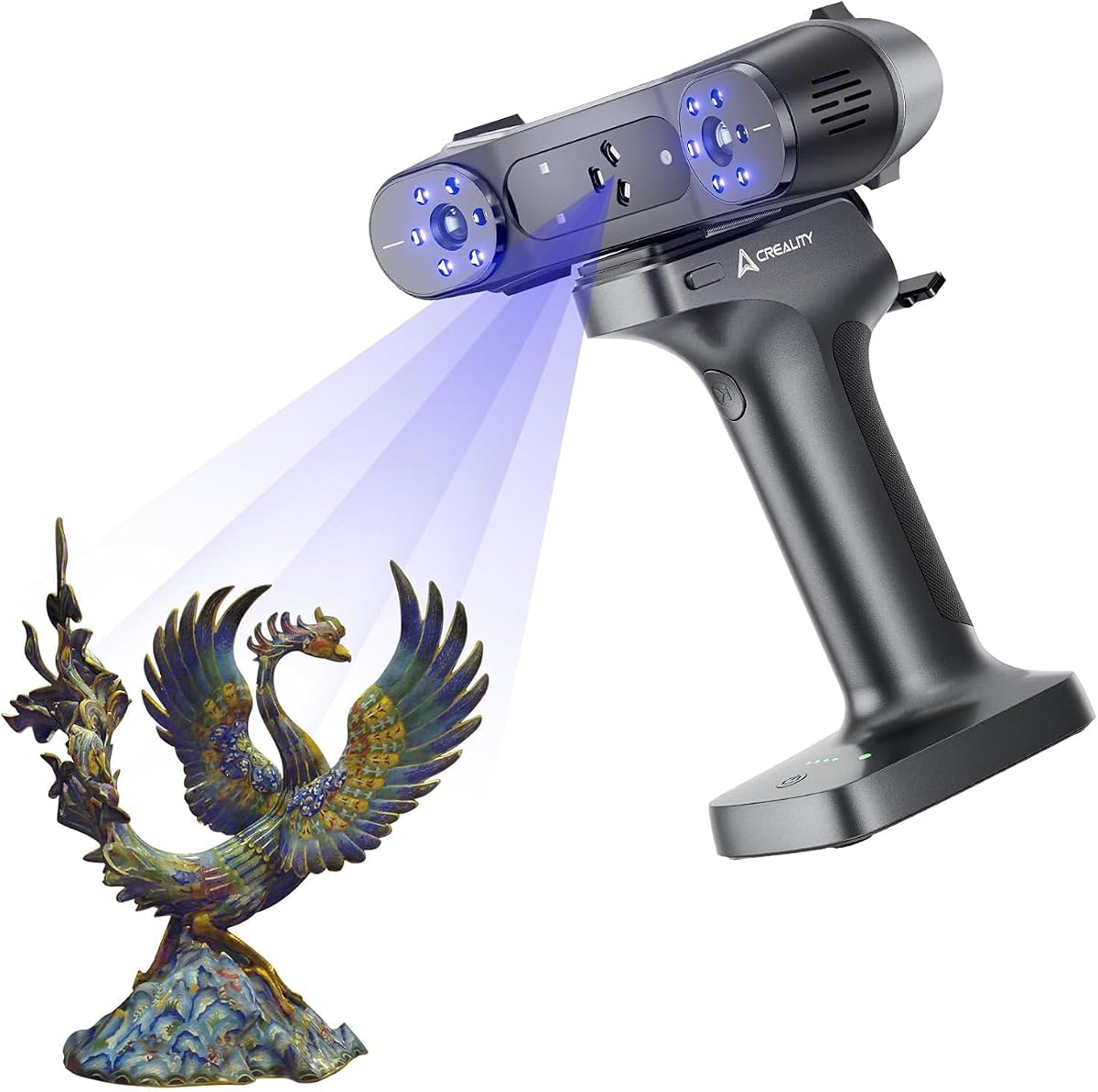
The EinScan Rigil offers complete wireless independence with onboard computing and Wi-Fi 6. This allows scanning without tethering to a PC, which is rare in this price range. The hybrid light source ensures precision across diverse materials and environments effectively.
We may earn a commission when you buy through this link, at no additional cost to you.
Its ability to handle direct sunlight and reflective surfaces without markers simplifies field inspections significantly. The included accessories and training resources ensure you can start using it quickly. This makes it a comprehensive solution for complex engineering needs.
The premium price reflects its advanced standalone features but might exceed some budgets. There is also a slight learning curve due to its extensive capabilities. However, the freedom it provides justifies the cost for many professionals.
Users seeking maximum mobility and advanced features will appreciate the Rigil thoroughly. It delivers high fidelity scans without constant reliance on external hardware. This makes it an excellent premium choice for modern reverse engineering.
Onboard computing allows scanning without being tethered to a computer or power source.
Combined blue laser and IR technology handle various surface conditions seamlessly.
We may earn a commission when you buy through this link, at no additional cost to you.
The Creality Raptor Pro handles objects from tiny 5mm parts to massive 4000mm structures. Its 24-bit color capture ensures rich texture data for detailed visual analysis. The hybrid laser setup provides flexibility for both fine details and broad surfaces.
We may earn a commission when you buy through this link, at no additional cost to you.
Temperature compensation algorithms maintain stability in various environments, making it suitable for industrial settings. It scans black and metallic objects directly without spray, saving prep time for complex parts. Compatibility with major 3D software aids integration into workflows.
Its weight might be noticeable during long handheld sessions compared to lighter models. Additionally, mastering the advanced features requires time and practice. However, these factors are often outweighed by its broad adaptability and precision.
Engineers needing a versatile tool for varied project sizes should choose this model. The ability to switch seamlessly between small details and large assemblies is invaluable. It remains a robust option for comprehensive reverse engineering tasks.
Capable of capturing both minute mechanical parts and large automotive components.
High-fidelity texture mapping enhances visual inspection and documentation.
We may earn a commission when you buy through this link, at no additional cost to you.
The INSPIRE 2 is designed for portability, weighing only 190 grams for easy transport. Its optical zoom feature allows focusing on specific mixed-geometry areas for better detail capture. This makes it a practical choice for on-site inspections or quick checks.
We may earn a commission when you buy through this link, at no additional cost to you.
Dual infrared laser modules help scan challenging surfaces without needing extra spray materials. The included outdoor filters ensure reliability in semi-bright conditions. Calibration is straightforward, making it accessible for users new to 3D scanning.
Precision is slightly lower than industrial-grade options, which may limit high tolerance needs. Battery life is moderate, so frequent charging might be needed for long sessions. Still, it offers excellent value for portable scanning tasks.
Professionals needing a compact, mobile solution will find this scanner ideal. It balances weight and functionality effectively for field work. It is a solid pick for reverse engineering where mobility is a priority.
Lightweight build reduces fatigue during extended handheld scanning sessions.
Adjustable optical zoom helps capture small details on complex surfaces.
We may earn a commission when you buy through this link, at no additional cost to you.
The Otter Lite provides accessible reverse engineering capabilities at a budget-friendly cost. With 0.05 mm precision, it captures sufficient detail for many prototyping tasks. The kit includes everything needed to start scanning right out of the box.
We may earn a commission when you buy through this link, at no additional cost to you.
Its dual-mode scanning allows switching between close-range and long-range depending on object size. RGB and infrared cameras capture true-to-life colors for better texture visualization. This makes it suitable for both hobbyist and light professional use.
While precise for its price, it cannot match the resolution of higher-end industrial scanners. Scanning speeds are moderate, which might be slow for large or detailed projects. However, for beginners or small-scale work, it offers great value.
Those seeking an affordable way to explore reverse engineering will find this tool useful. It provides essential features without overwhelming complexity. It is a smart starting point for entry-level scanning needs.
Provides solid precision and accessories at a very competitive entry price point.
Switches easily between close small parts and larger objects seamlessly.
We may earn a commission when you buy through this link, at no additional cost to you.
This standard version offers industrial-grade blue laser performance at a competitive price. It captures high-quality data suitable for reverse engineering without needing extra accessories. The four scanning modes provide flexibility for different object types and conditions.
We may earn a commission when you buy through this link, at no additional cost to you.
You can scan shiny or dark surfaces directly without using powder spray, simplifying workflows. Real-time streaming helps you monitor progress on mobile devices easily. Auto turntable options automate scans for consistent results on complex parts.
Advanced CAD tools are sold separately, which adds to the total cost. Additionally, support is limited to Windows systems for those tools. Despite this, the core scanning hardware remains powerful and reliable.
Users prioritizing scanning performance over bundled software will appreciate this model. It delivers professional results efficiently. It remains a top choice for practical reverse engineering tasks.
Delivers consistent high accuracy suitable for detailed engineering tasks.
Auto turntable and multiple modes reduce manual setup time.
We may earn a commission when you buy through this link, at no additional cost to you.
The Raptor Pro is built for challenging environments with high light tolerance. Its metrology-grade accuracy ensures reliable measurements even on rough or large objects. This versatility makes it ideal for automotive or industrial site inspections.
We may earn a commission when you buy through this link, at no additional cost to you.
Advanced laser configurations capture complex curves without spray. The CrealityScan software simplifies workflow with step-by-step tutorials and editing tools. Face and body modes add flexibility for unique reverse engineering projects.
Operating this scanner demands a powerful computer with specific GPU and RAM. Additionally, its weight can cause fatigue during prolonged use. However, the scanning quality and adaptability make these trade-offs manageable.
Professionals requiring outdoor capability and high precision will find this scanner effective. It handles demanding tasks well and provides reliable data. It is a strong contender for versatile reverse engineering needs.
Resistant to bright sunlight ensuring consistent results in field conditions.
Included software streamlines processing and editing for better efficiency.
We may earn a commission when you buy through this link, at no additional cost to you.
The Raptor X delivers speed with 60 FPS scanning and Wi-Fi 6 wireless capabilities. This lossless data transfer ensures high fidelity during remote transmission. The large battery supports extended sessions away from outlets.
We may earn a commission when you buy through this link, at no additional cost to you.
Its anti-shake technology helps maintain accuracy during handheld movement. Full 24-bit color scanning enhances texture details for better visual models. These features make it suitable for dynamic industrial environments.
The price is higher than average, reflecting its advanced technology. Also, mastering its full potential requires time and practice. Still, the speed and wireless freedom offer significant advantages.
Users needing fast, mobile scanning solutions will value this scanner highly. It balances speed with portability effectively. It is a strong choice for demanding reverse engineering tasks.
Lossless Wi-Fi 6 transmission ensures data integrity during remote use.
Anti-shake algorithms maintain accuracy during handheld scanning movement.
We may earn a commission when you buy through this link, at no additional cost to you.
This Raptor Pro combines high precision with rich color capture for detailed models. Its metrology-grade accuracy makes it ideal for strict reverse engineering requirements. Dual lasers allow efficient capture of complex geometries and textures.
We may earn a commission when you buy through this link, at no additional cost to you.
Wireless support and full-color scanning enhance portability and visual fidelity. The system accommodates diverse object sizes from small parts to large assemblies. This flexibility is essential for varied engineering projects.
Strict hardware requirements might limit use on older systems. Additionally, the software learning curve could slow initial adoption. However, once mastered, it delivers powerful results.
Users needing accuracy and color together will find this model advantageous. It supports versatile applications from automotive to artifacts. It remains a top pick for comprehensive reverse engineering.
0.02mm precision ensures high reliability for strict engineering specs.
Fast color scanning saves time while maintaining detailed texture data.
We may earn a commission when you buy through this link, at no additional cost to you.
Selecting the right scanner depends on your specific project needs and technical environment. Consider these key factors before purchasing to ensure compatibility and performance.
For reverse engineering, accuracy is critical to ensure CAD models match physical parts. Look for scanners offering 0.02 mm or better tolerance for industrial applications. Higher resolution ensures fine details and sharp edges are captured without loss.
Prioritize models with verified metrology-grade accuracy for professional results.
Faster frame rates reduce data capture time significantly for large or complex objects. Scanners with 60 FPS or higher improve productivity especially in high volume workflows. However, ensure speed does not compromise data quality in your use case.
Choose higher speeds if time efficiency is a primary concern for your team.
Many industrial parts have shiny, dark, or reflective surfaces that challenge standard scanners. Blue laser or hybrid light systems allow direct scanning without spray powders. This saves preparation time and protects delicate parts from contamination.
Confirm the scanner handles your typical object materials without extra prep.
The scanner's software determines how easily you can edit and export data. Ensure the software supports your operating system and integrates with CAD tools like SolidWorks. Some systems require separate licenses for advanced reverse engineering features.
Check software compatibility and costs before committing to a hardware model.
Wireless support enhances mobility, allowing you to scan in different locations freely. Wi-Fi 6 offers stable high-speed data transfer reducing cable clutter. This is especially useful for outdoor or large facility inspections.
Consider wireless features if you need scanning flexibility across multiple areas.
Lightweight scanners reduce fatigue during extended handheld sessions. Look for ergonomic designs and included battery grips for field use. If you move between sites often, a portable unit improves overall workflow efficiency.
Choose lighter models if portability is essential for your daily tasks.
Ensure the scanner covers your required object sizes from tiny parts to large assemblies. Some models offer dual-range modes for flexibility in different project scales. This adaptability prevents needing multiple devices for varied work.
Verify the scanning volume meets your largest and smallest item needs.
Full-color scanning adds visual fidelity crucial for heritage or aesthetic designs. High-resolution color mapping helps in accurate surface inspection and documentation. Not all industrial scanners include this feature, so check if needed.
Prioritize color capability if visual detail is important for your output.
Begin by calibrating the scanner using the included board before each session. Proper calibration ensures data accuracy and prevents alignment errors during processing. Always clean lenses with a soft cloth to maintain optimal light transmission.
Keep the device in a dry, temperate environment to avoid internal component damage. Store the scanner and accessories in the provided carrying case when not in use. Regularly update software to benefit from new features and bug fixes.
During scanning, maintain consistent speed and distance for smooth data acquisition. Avoid strong direct sunlight unless using a model designed for outdoor conditions. Review captured data immediately to catch gaps or errors before finalizing models.
Most industrial applications require at least 0.02 mm precision to ensure CAD models fit properly. Lower tolerances may be acceptable for prototyping but not for manufacturing. Always verify requirements based on your specific engineering standards.
Modern blue laser scanners can capture reflective or dark surfaces without spray. This simplifies the workflow and protects delicate parts. Check your specific scanner's capabilities for no-spray functionality.
Some models are designed to handle direct sunlight up to 100,000 lux. Others may require shaded environments to maintain accuracy. Choose outdoor-ready models for field inspections.
Software like Revo Design, SolidWorks, or Geomagic are commonly used for conversion. Ensure compatibility with your scanner's export formats. Many scanners include basic editing tools for initial processing.
Always calibrate using the provided board and clean lenses. Ensure lighting matches the scanner's environmental recommendations. Check that accessories like markers or turntables are ready if needed.
Yes, scanners with large object range capabilities can capture automotive parts. You may need multiple scans to cover all areas. Stitching software helps merge these into a single model.
High-performance GPUs are recommended for faster processing of complex scans. Entry-level units work on standard PCs, but professional models need more power. Check system requirements before purchasing.
Battery life varies from 2 to 4 hours depending on usage and settings. Carry spare batteries for long sessions to avoid interruptions. Wireless models offer more flexibility for remote scanning.
The ten scanners reviewed here provide robust options for various engineering needs from entry-level to industrial. Each model balances precision, speed, and usability to help you digitize physical objects accurately. Choosing the right one depends on your specific project requirements.
Prioritize accuracy and surface compatibility if you work with challenging materials regularly. For mobile needs, consider wireless and lightweight options to improve flexibility. Software integration is equally important to ensure smooth data conversion.
Always verify current prices and availability before purchasing as offers change frequently. Our expert guide aims to simplify your selection process with honest comparisons. Investing in the right scanner will enhance your reverse engineering efficiency.