
HiLetgo W5500 SPI to LAN Ethernet Network Module
4.3Editor score
3.3V 5V compatible
SPI interface support
Compact design layout
This guide compares the top Arduino Lan Ethernet Module options for reliability, speed, and ease of use in your next IoT or networked project today.
Connecting your Arduino to a local network opens up a world of possibilities for IoT projects and automation. Finding the right Ethernet module ensures stable data transmission and reliable communication without worrying about wireless interference issues.
We evaluated ten popular Arduino Lan Ethernet Module options based on chip architecture, interface speed, and community support. Each entry represents a distinct choice for hobbyists and professionals seeking wired connectivity solutions for their microcontroller projects.
Every selection below highlights specific strengths and potential limitations to help you decide quickly. Keep in mind that stock levels and pricing can fluctuate frequently, so verifying current availability is always recommended before finalizing your purchase decision.
4.3Editor score

4.2Editor score

4.7Editor score
The following table offers a quick side-by-side view of the main technical specifications and key features across all ten selected Ethernet modules for Arduino systems.



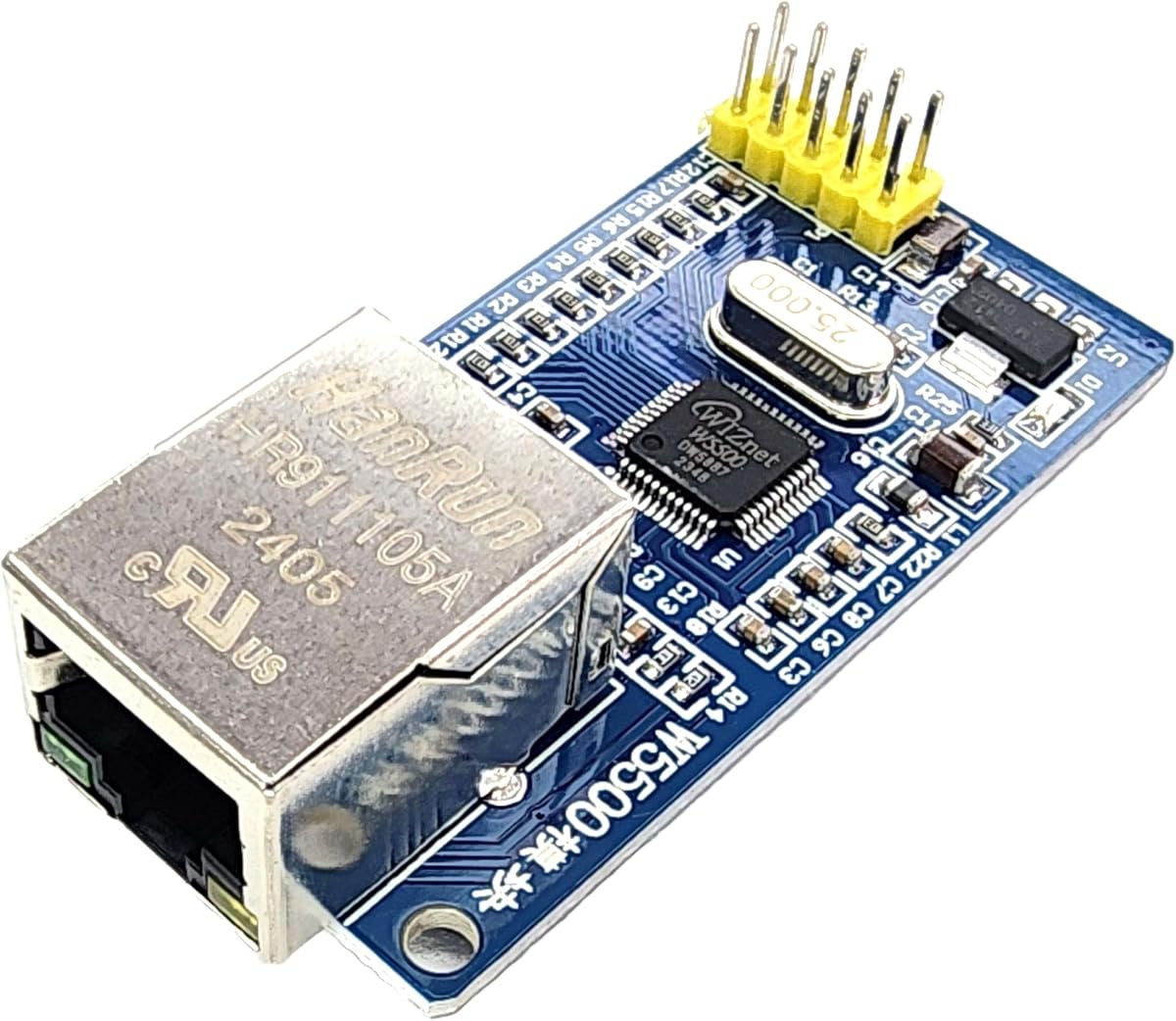

This module stands out as a top choice for reliable network connectivity using the robust W5500 chip. With a strong community rating and support for both 3.3V and 5V logic, it fits seamlessly into most Arduino and STM32 environments.
We may earn a commission when you buy through this link, at no additional cost to you.
The hardware TCP/IP stack offloads processing tasks from your microcontroller, freeing up cycles for other critical operations. Its internal 32k memory buffers ensure smooth data handling even under load, while eight independent sockets allow multiple connections simultaneously.
While it is not a shield form factor requiring direct wiring, the SPI interface is straightforward for developers familiar with standard protocols. The dual voltage tolerance makes it adaptable to different board requirements without extra level shifters.
Ideal for IoT gateways or data logging stations, this kit provides excellent value with two units included. Choose this if you need stable Ethernet connectivity without the overhead of managing TCP/IP software on your microcontroller.
The integrated stack handles packet routing and protocol logic independently. This reduces CPU load significantly on devices like Arduino Uno or ESP8266.
Eight sockets enable simultaneous HTTP clients and servers. Perfect for projects needing bidirectional communication with cloud services.
We may earn a commission when you buy through this link, at no additional cost to you.
For hobbyists seeking an entry point into wired networking, this module offers a balanced feature set at a competitive price. The W5500 chipset provides the same reliability seen in more expensive solutions but in a minimal form factor.
We may earn a commission when you buy through this link, at no additional cost to you.
It requires a steady external power supply of at least 200mA to ensure stability during high traffic bursts. The 3.3V SPI interface aligns well with modern boards, though careful voltage matching is necessary when interfacing with 5V systems directly.
Users appreciate its compatibility with STM32 interfaces and ease of integration into breadboard setups. However, you must ensure your power source is robust to avoid brownouts during data transmission spikes.
This is the go-to option for prototyping or single-unit projects where cost is a primary constraint. If you prioritize affordability without sacrificing essential Ethernet performance, this module delivers consistent results.
External power mode demands consistent voltage and current. Ensure your USB hub or adapter can supply the required 200mA continuously.
TTL SPI signals are designed for 3.3V. Use level shifters if connecting directly to 5V GPIOs to prevent damage.
We may earn a commission when you buy through this link, at no additional cost to you.
Buying in bulk often makes sense for larger deployments or classrooms where multiple setups are needed. This five-pack ensures you have spares on hand for testing or expanding your network without ordering again soon.
We may earn a commission when you buy through this link, at no additional cost to you.
Each board adheres to strict power requirements, ensuring consistent operation under varied loads. The compact PCB size allows for flexible mounting options, whether you are prototyping on a breadboard or designing a custom enclosure.
While the upfront investment is higher, the per-unit cost remains competitive compared to individual purchases. Quality control on these modules reflects careful attention to signal integrity and connection stability over time.
Choose this pack if you plan to scale your project across several units or need redundancy. It offers peace of mind through quantity and reliability suitable for professional or educational applications.
Having five units allows for distributed sensor networks. You can place nodes in different rooms or locations easily.
The 23x25mm footprint fits neatly in tight enclosures. Careful layout helps avoid signal interference with other components.
We may earn a commission when you buy through this link, at no additional cost to you.
This module features a high-speed SPI interface capable of 80MHz operation, suitable for real-time control scenarios. Its industrial-grade PHY ensures stable connectivity even in challenging electromagnetic environments.
We may earn a commission when you buy through this link, at no additional cost to you.
The hardware stack supports TCP, UDP, ICMP, and PPPoE, offering versatility for different network protocols. With 32KB buffers, data transfer remains smooth during peak usage periods without packet loss.
However, the low rating suggests potential inconsistencies in quality or compatibility. Users may find documentation scarce compared to more established brands, requiring deeper debugging efforts during setup.
If you need specific features like Wake-on-LAN via UDP or high-speed data handling, consider this but verify compatibility with your specific microcontroller before purchase. It may suit niche applications where standard modules fall short.
80MHz SPI ensures quick data exchange with the host. This is beneficial for time-sensitive IoT sensor readings.
Embedded PHY handles auto-negotiation and duplex modes well. Designed for environments where stability is critical.
We may earn a commission when you buy through this link, at no additional cost to you.
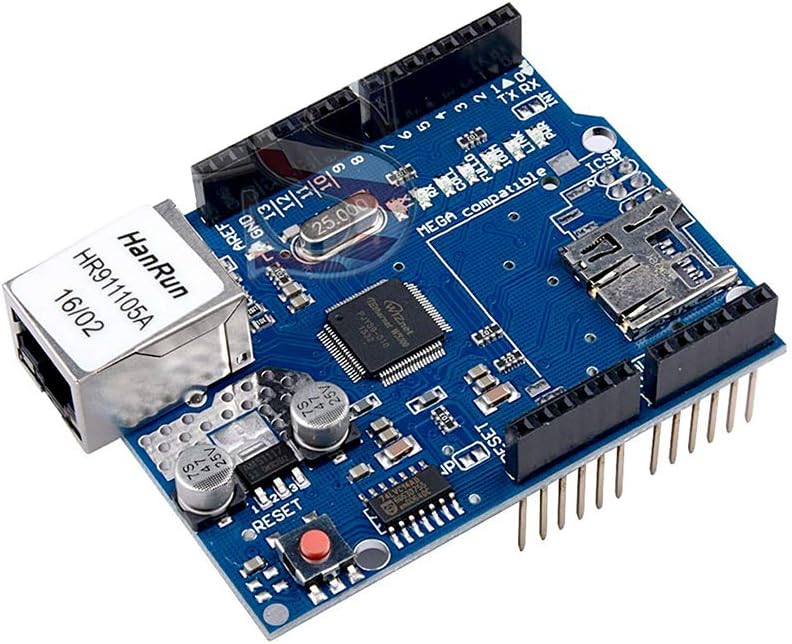
As a shield rather than a module, this option simplifies physical connection to Arduino boards like the Uno or Mega. It sits directly on top, providing instant Ethernet connectivity with minimal cabling effort.
We may earn a commission when you buy through this link, at no additional cost to you.
The inclusion of an SD card slot adds local storage capability, useful for logging data when network access is lost. This dual functionality makes it attractive for standalone data loggers that occasionally sync with servers.
The W5100 chip is proven and widely supported in libraries, though it is older than W5500 variants. Performance is adequate for basic web server tasks but may struggle with high concurrency or complex routing.
Ideal for beginners or projects needing SD card access alongside Ethernet. If ease of installation and library support are your top priorities, this shield offers a straightforward path to connectivity.
Stacks directly onto Arduino pins without extra wires. This reduces setup time significantly for prototyping sessions.
Integrated SD slot allows saving logs locally. Useful when internet connectivity is intermittent or unavailable.
We may earn a commission when you buy through this link, at no additional cost to you.
The ENC28J60 is a classic Ethernet controller known for low power consumption and broad compatibility. This module includes a 25MHz crystal and HR911105A isolation transformer to ensure signal integrity and safety.
We may earn a commission when you buy through this link, at no additional cost to you.
Unlike the W5500, the ENC28J60 relies on software libraries to handle TCP/IP protocols. This requires more processing power from your microcontroller but offers flexibility for custom networking tasks.
It operates strictly at 3.3V, so level shifting is needed if your board uses 5V logic. The compact design fits well in space-constrained applications where every millimeter counts.
Best suited for battery-powered or low-power projects where energy efficiency is paramount. If you have the MCU headroom to manage the stack, this module provides reliable networking at a minimal footprint.
ENC28J60 consumes less power than newer chips. Ideal for sleep-mode projects or solar powered setups.
HR911105A transformer protects your microcontroller from voltage spikes. Essential for outdoor or industrial networking.
We may earn a commission when you buy through this link, at no additional cost to you.
With a high user rating, this five-pack represents excellent value for those building multiple devices. The ENC28J60 remains relevant for simple IoT nodes where complex throughput is not required.
We may earn a commission when you buy through this link, at no additional cost to you.
IEEE 802.3 compliance ensures compatibility with standard Ethernet networks. The included HR911105A isolation transformer is a key feature that enhances reliability during long-term deployments.
Users report stable performance with proper power conditioning. While not the fastest option available, it delivers consistent results for basic web client or server tasks.
Select this if you need many units for a sensor network or classroom project. The high rating suggests quality control is better than average for this component class.
Adheres to IEEE 802.3 specifications. Guarantees interoperability with switches and routers globally.
Five units reduce per-item cost significantly. Allows experimentation with multiple network configurations simultaneously.
We may earn a commission when you buy through this link, at no additional cost to you.
This module receives perfect ratings from users who value straightforward setup and wide compatibility. It bridges the gap between Arduino and ESP-based boards effortlessly, offering dual voltage support for flexibility.
We may earn a commission when you buy through this link, at no additional cost to you.
The standard RJ45 port simplifies physical cabling, while SPI ensures fast data rates. Tutorials and sample codes are readily available, making it ideal for educational or DIY IoT applications.
It supports full TCP/IP and UDP protocols, enabling robust communication with web servers and MQTT brokers. Performance is stable, with few reports of connection drops or configuration issues.
A strong recommendation for beginners or rapid prototyping where reliability and resources matter. If you are unsure which module to pick, this one minimizes friction in the learning curve.
Extensive tutorials help you start quickly. Search online for DIY code examples specific to this module model.
Works with ESP32 and ESP8266 as well. Expands project possibilities beyond classic Arduino boards.
We may earn a commission when you buy through this link, at no additional cost to you.
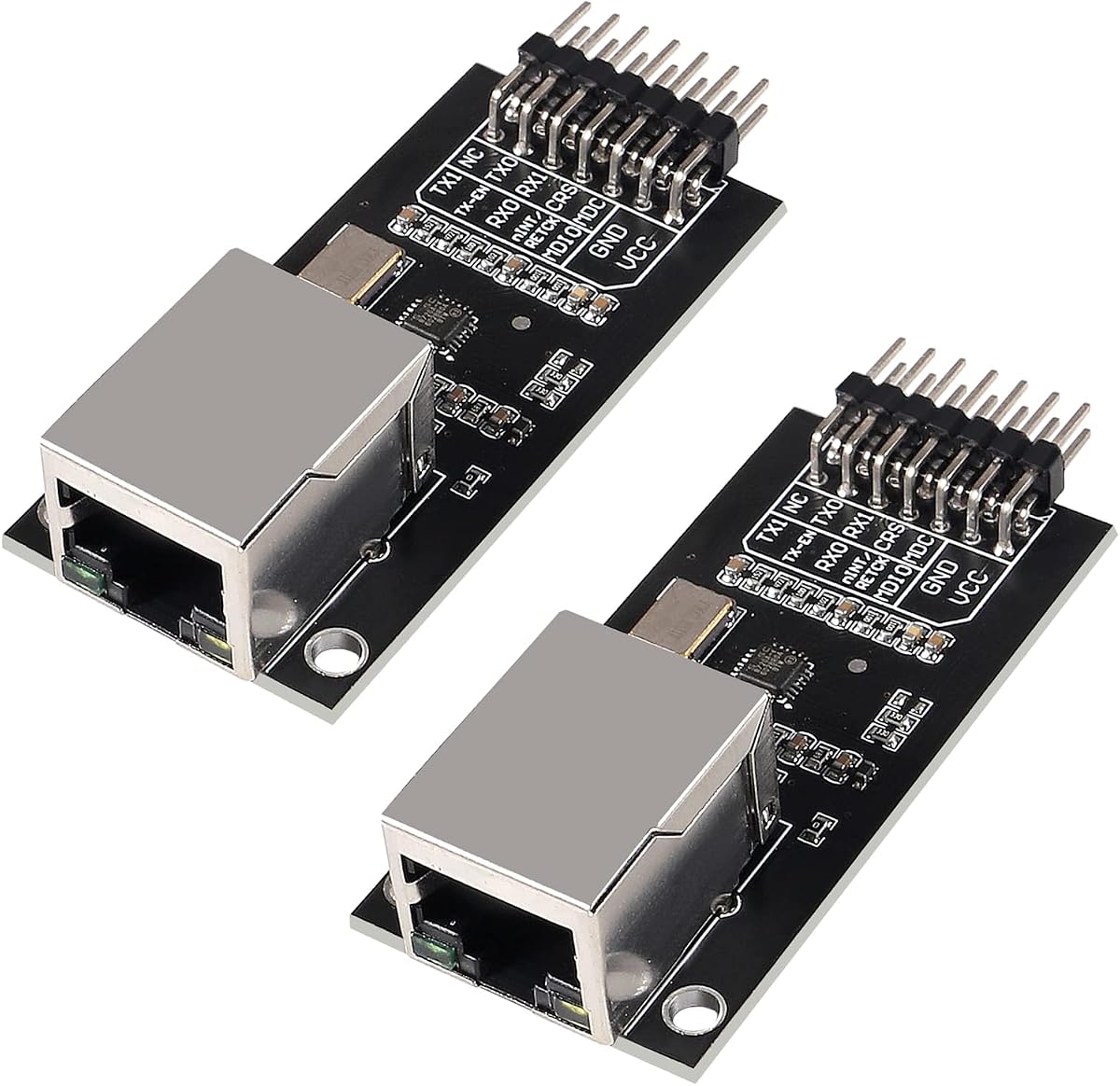
The LAN8720 is a dedicated PHY transceiver offering high-speed Ethernet performance without the full stack. This kit includes two units, suitable for projects requiring embedded web server capabilities or custom routing logic.
We may earn a commission when you buy through this link, at no additional cost to you.
Auto-MDIX supports flexible cable connections without manual cross-over requirements. Ultra-low power design allows operation from a single 3.3V supply, making it suitable for energy-conscious deployments.
Integration may require more effort than plug-and-play modules since you must handle higher-level protocols. Reviews suggest varying levels of success depending on the specific hardware and software environment.
Choose this if you need raw PHY control or specific web server features. It suits advanced users comfortable managing Ethernet protocols directly on the microcontroller.
Auto-MDIX handles straight or crossover cables automatically. Simplifies wiring when switching between devices.
Designed for efficient operation in low-power scenarios. Suitable for battery-based remote sensing stations.
We may earn a commission when you buy through this link, at no additional cost to you.
This module delivers reliable performance with a high user rating, reflecting consistent quality from the manufacturer. The DIP28 package for the ENC28J60 chip ensures durability and standard interfacing options.
We may earn a commission when you buy through this link, at no additional cost to you.
It includes the HR911105A isolation transformer, protecting your project from electrical noise and ensuring safer operation. The 25MHz crystal provides stable timing for accurate data transmission over the network.
While it does not offer advanced features like hardware TCP offloading, it works well for basic connectivity tasks. Users find it easy to integrate with various microcontrollers including AVR and STM32.
An excellent choice for simple networking needs where cost and reliability matter most. If you prefer proven technology over cutting-edge specs, this module delivers consistent performance.
DIP28 package provides mechanical robustness. Useful for prototyping boards that undergo frequent changes.
25MHz crystal maintains accurate SPI timing. Ensures data integrity across different communication rates.
We may earn a commission when you buy through this link, at no additional cost to you.
Choosing the right Ethernet module involves balancing chip capabilities, interface types, and project requirements. This guide outlines key factors to consider before you buy.
Modern modules use W5500 or W5100 chips that handle TCP/IP in hardware, reducing CPU load. Older ENC28J60 chips rely on software stacks which require more processing power but remain valid for simple tasks.
Look for a chip that matches your microcontroller's performance capabilities and memory constraints.
SPI is the standard interface for most Ethernet modules, offering a balance of speed and simplicity. Ensure your board supports SPI communication and that voltage levels match the module requirements.
Verify that your microcontroller's SPI pins are accessible and configured correctly in your code.
Ethernet modules often draw significant current, especially during data transmission. Ensure your power supply can deliver at least 200mA without voltage drops that could cause instability.
Use dedicated power sources or high-current USB adapters to prevent brownouts during active use.
Modules operating at 3.3V logic need level shifters when connecting to 5V boards. Some support both voltages natively, simplifying wiring and reducing the risk of logic errors.
Check the datasheet to confirm logic levels and decide if additional hardware is needed.
Shield modules stack directly on boards for easy installation but occupy header space. Standalone modules require wiring but offer flexibility in placement and layout for custom enclosures.
Choose a form that fits your enclosure size and wiring preferences.
Hardware TCP/IP stacks support common protocols like HTTP and MQTT out of the box. Software-based modules may need additional libraries which can increase complexity and RAM usage.
Select a module that aligns with your communication needs.
Some modules include RJ45 ports, while others require separate jacks. Integrated ports simplify physical connections and reduce the number of external components required for assembly.
Prefer modules with built-in RJ45 for cleaner setups and better signal isolation.
Popular modules have extensive libraries, forums, and tutorials available online. This support accelerates development and helps troubleshoot issues quickly without needing deep networking knowledge.
Check for active user bases and up-to-date software libraries before purchasing.
Start by connecting the power and SPI pins correctly according to the datasheet. Ensure ground connections are shared between the microcontroller and the module to maintain stable reference levels.
Install the appropriate Ethernet library in your IDE and configure your IP settings. Use static or DHCP as needed for your network environment to establish reliable connectivity.
Keep the module away from heat sources and static discharge to extend its lifespan. Regularly inspect wiring connections and ensure cables are not under tension to prevent mechanical failure.
Modules like the W5500 Ethernet TCP/IP with clear documentation are ideal. They handle the network stack internally and have widespread library support, making setup straightforward for newcomers.
Yes, most Ethernet modules operate at 3.3V logic. Using level shifters when connecting to 5V boards protects the module from overvoltage and ensures reliable communication between components.
Hardware TCP/IP offloads packet handling to the chip, saving CPU resources. Software TCP/IP requires the microcontroller to manage the stack, which can be slower but more flexible for custom protocols.
Yes, many modules are compatible with ESP32 and ESP8266 boards. Just ensure voltage levels match and use libraries designed for those platforms to handle communication properly.
Typically, at least 200mA at 3.3V is required for stable operation. A weak power supply can lead to connection drops or failures during high network activity.
Standard CAT5e or CAT6 Ethernet cables work best with RJ45 ports. Ensure the cable is functional and matches your network speed requirements for optimal performance.
The top picks range from budget W5500 modules to versatile ENC28J60 options depending on your specific project needs. Prioritize stability and power requirements to avoid common pitfalls during development.
Consider how much processing power your microcontroller has when selecting between hardware and software stacks. A well-chosen module can save hours of debugging and improve overall project reliability.
Always check current prices and availability before purchasing as stock levels change frequently. With the right Ethernet module, your Arduino projects can connect to the wider world with confidence.