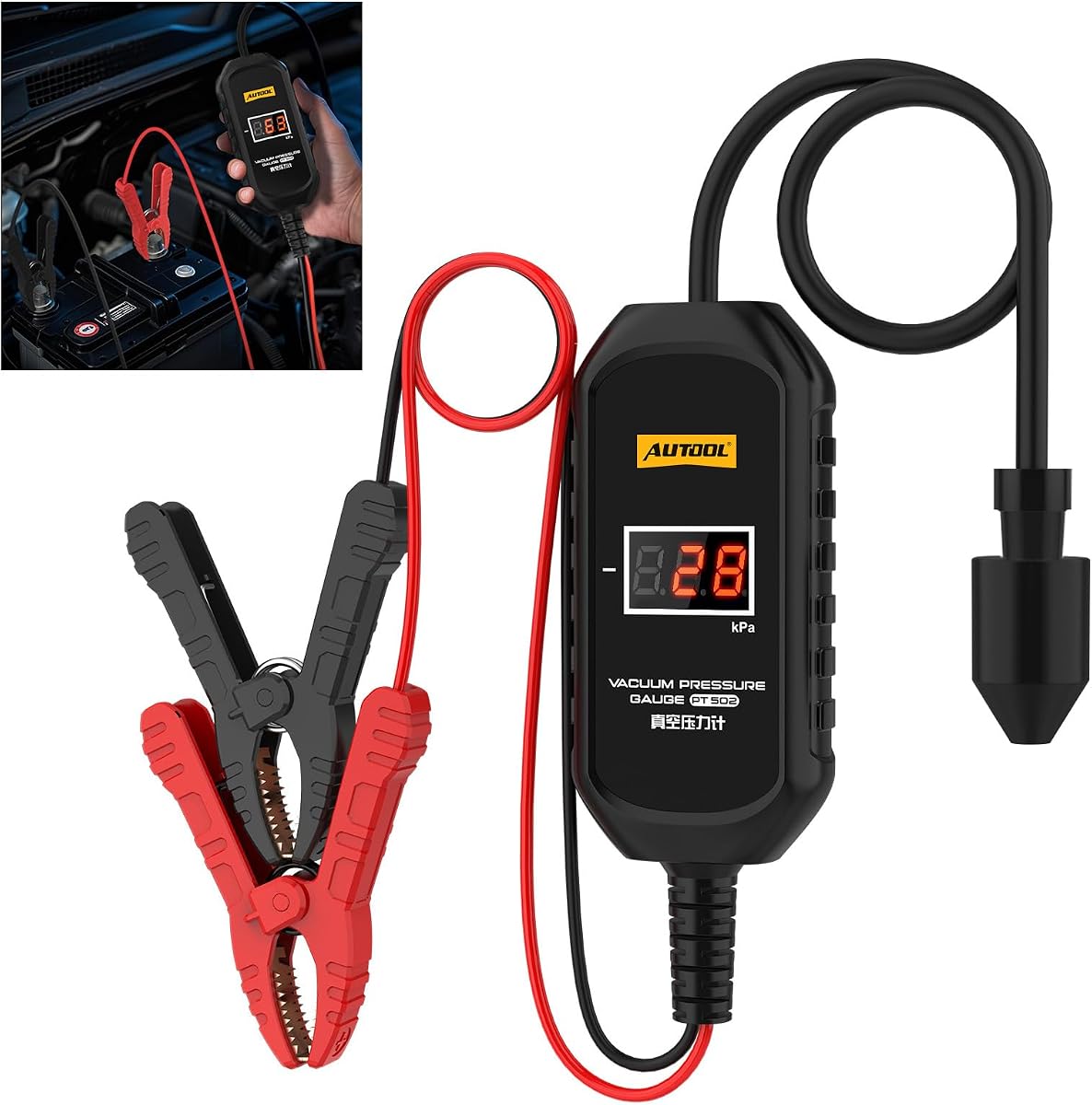
AUTOOL PT502 Digital Vacuum Pressure Gauge
4.4Editor score
101kPa high accuracy range
Automatic temperature compensation
12V car powered operation
Digital vacuum gauges are essential tools for HVAC technicians and automotive professionals who need precise pressure readings. They help ensure systems are free of moisture and air before refrigerant charging, which is critical for efficiency and longevity.
We evaluated ten leading models based on accuracy, range, display clarity, and additional features like leak detection and wireless connectivity. Our analysis covers both budget-friendly options and high-end professional tools designed for demanding environments.
Each pick highlights key specifications and real-world performance to help you find the right gauge for your needs. Please note that prices and availability can change frequently, so verify current details before purchasing your next tool.
4.4Editor score

4.5Editor score

4.3Editor score
As an Amazon Associate we earn from qualifying purchases.
The following table provides a side-by-side comparison of all ten digital vacuum gauges reviewed in this guide, highlighting key specifications and unique features for easy selection.



The CPS VG200 stands out as a top choice for professionals due to its NIST-calibrated accuracy. It offers reliable readings across multiple units, making it versatile for various HVAC tasks.
We may earn a commission when you buy through this link, at no additional cost to you.
Its automatic temperature compensation ensures consistent data regardless of environmental conditions. The large 5-digit LCD display is easy to read even in bright sunlight or dim workshops.
While the price is higher than budget models, the durability and included accessories like the T-fitting and padded case justify the investment. It withstands up to 400 PSI positive pressure without damage.
Technicians seeking a dependable tool for precise evacuation and leak detection will find this gauge invaluable. It balances performance with usability effectively for daily field work.
Calibration to strict NIST standards ensures that every reading you take is trustworthy and repeatable across different job sites and conditions.
Switching between microns, millibar, torr, and inches/hg with just two buttons allows you to adapt quickly to any system requirements without confusion.
We may earn a commission when you buy through this link, at no additional cost to you.
This model offers advanced features like smart evacuation and leak detection modes at a very competitive price. It is ideal for those who need more than basic pressure readings.
We may earn a commission when you buy through this link, at no additional cost to you.
The evacuation mode displays key parameters like temperature difference and water vapor saturation, helping you confirm moisture removal effectively. The leak test mode shows pressure differentials clearly.
While the user rating is lower than some competitors, the feature set is impressive for the cost. However, some users report inconsistent battery performance over time.
It is a strong contender for DIYers or technicians who want smart diagnostics without spending a premium. Check warranty terms before purchasing to ensure long-term support.
This mode monitors evacuation progress with parameters like temperature difference, ensuring air and moisture are completely purged from your system effectively.
The leak test mode displays pressure differentials and test duration, giving instant clarity on whether your system seal remains intact during static testing.
We may earn a commission when you buy through this link, at no additional cost to you.
The testo 552i connects wirelessly to digital manifolds, saving time during complex service jobs. It delivers reliable vacuum measurements with a clear smart app interface for documentation.
We may earn a commission when you buy through this link, at no additional cost to you.
Its IP54 protection ensures durability against dust and water in demanding environments. The 45-degree service port design reduces strain during installation on tight ports.
This tool is best suited for professionals already invested in the testo ecosystem. It requires specific manifolds for full functionality, which may add to the overall cost.
If workflow efficiency and digital documentation are priorities, this probe is an excellent choice. It simplifies the evacuation process significantly for busy service teams.
Connects automatically to testo digital manifolds, allowing live data viewing on your device without interrupting your physical workflow during service calls.
The Smart App lets you document results directly on your tablet, control tasks remotely, and send reports instantly from the job site for better client records.
We may earn a commission when you buy through this link, at no additional cost to you.
This gauge is designed for portability with a pocket-sized form factor. It uses a Pirani sensor for fast readings and includes a visual alarm to signal target vacuum levels.
We may earn a commission when you buy through this link, at no additional cost to you.
The backlit LCD ensures readability in low-light conditions, which is common when working under equipment. It supports multiple pressure units for flexibility in different regions.
However, the build quality may not match heavier-duty models for extreme conditions. It is best suited for lighter service tasks or as a backup tool in the field.
For technicians who prioritize size and weight, this option is worth considering. Ensure you handle it with care to maintain sensor accuracy over time.
Its compact shape fits easily in your tool bag, making it convenient to carry for quick checks or remote service calls.
Built-in alerts activate once the preset vacuum level is reached, preventing over-evacuation and saving time during system evacuation.
We may earn a commission when you buy through this link, at no additional cost to you.
This gauge supports an extensive range of 0-75,000 microns, making it suitable for various system types. It features a professional dual calibration system to ensure accuracy over time.
We may earn a commission when you buy through this link, at no additional cost to you.
Smart temperature compensation helps adjust readings in real-time to counteract sensor drift. The large backlit LCD allows clear monitoring even in dark service areas.
The 14 PSI overpressure protection adds durability against accidental pressure spikes. However, some users note that sensor calibration is required periodically.
It is a solid choice for technicians needing a broad range without breaking the bank. Regular calibration ensures it remains reliable for long-term use.
Measures from 0 to 75,000 microns, covering a broad spectrum of vacuum levels needed for different HVAC and refrigeration tasks.
Designed with 14 PSI protection to withstand accidental pressure spikes, enhancing durability in demanding HVAC environments.
We may earn a commission when you buy through this link, at no additional cost to you.
The Supco VG64 is known for its durability and compatibility with A2L refrigerants. It offers a range up to 12,000 microns, which is sufficient for most residential HVAC tasks.
We may earn a commission when you buy through this link, at no additional cost to you.
Its sensor maintains accuracy even when exposed to oil residue, reducing maintenance needs. The backlit LCD provides a quick 0.5-second response time for real-time monitoring.
While the magnetic strap is a nice touch, it may not hold securely on all surfaces. The unit is compact and lightweight for easy transport in the field.
Ideal for professionals handling modern refrigerants and needing a reliable backup gauge. Its simplicity makes it a favorite for routine maintenance.
Compatible with A2L refrigerants, ensuring safe and accurate vacuum measurement during the transition to new HVAC standards.
Highly durable sensor maintains accuracy when exposed to oil residue, typically requiring no cleaning during normal operation.
We may earn a commission when you buy through this link, at no additional cost to you.
This wireless model integrates with the Elitech Tools app, allowing data management across multiple tools. It features offline recording and export options for reports in Excel or PDF.
We may earn a commission when you buy through this link, at no additional cost to you.
The app can judge the physical state of water (H2O) using temperature and vacuum data. This intelligent feature helps ensure moisture is thoroughly removed from the system.
While connectivity adds convenience, it requires a stable connection and app familiarity. The rechargeable battery reduces the need for replacements during extended use.
Good for tech-savvy technicians who want to centralize their tool management. Verify app compatibility with your smartphone before buying.
The upgraded app lets you manage vacuum pumps, gauges, and scales on one platform, streamlining your workflow across different tools.
Data can be recorded offline and exported later, ensuring you never lose critical measurement history even without internet access.
We may earn a commission when you buy through this link, at no additional cost to you.
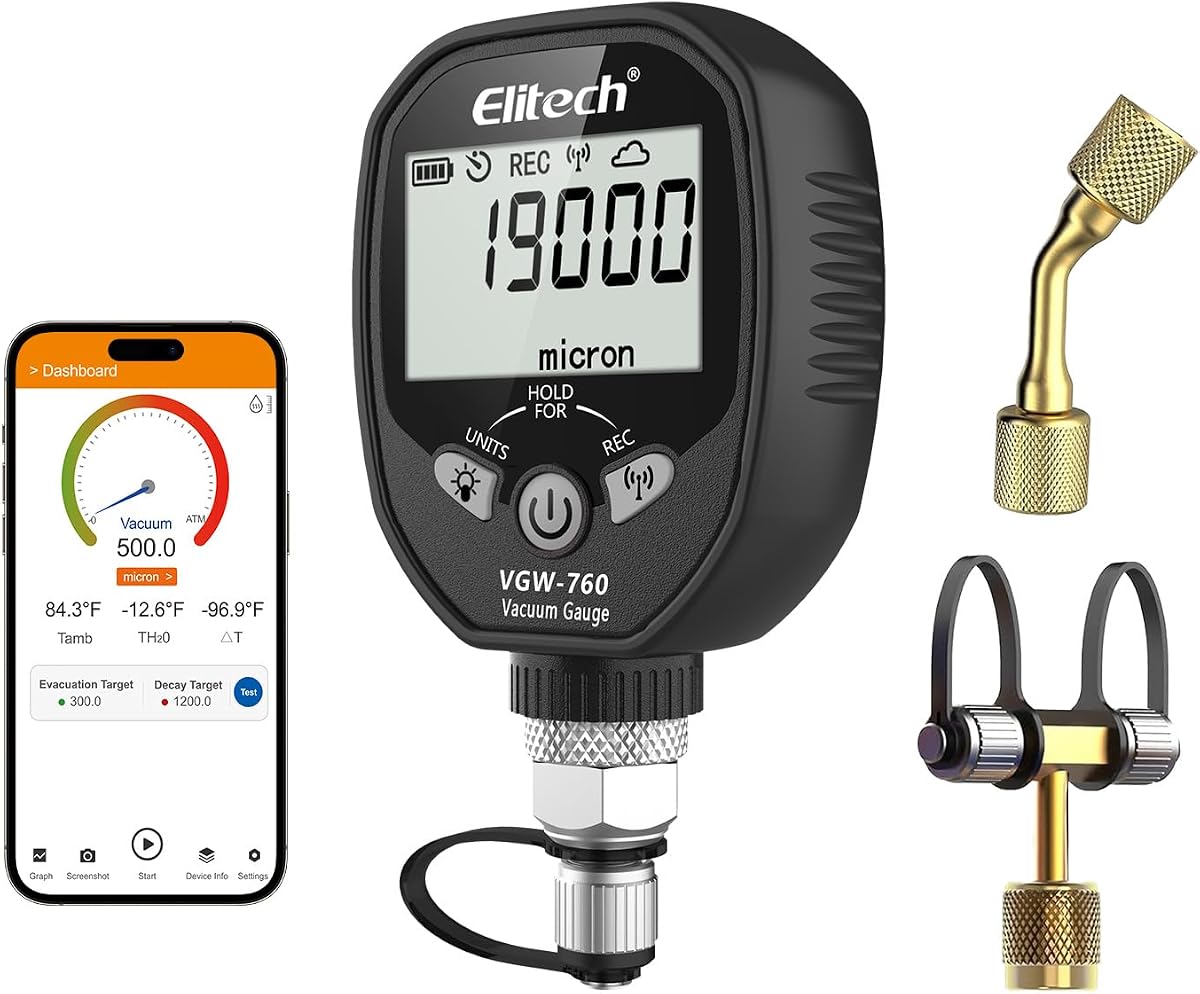
This model extends the range to 760,000 microns, covering atmospheric pressure down to deep vacuum. It shares the app connectivity features of the VGW-Mini for enhanced data management.
We may earn a commission when you buy through this link, at no additional cost to you.
It allows you to discern vacuum pump quality and test system leaks effectively. The intelligent H2O judgment ensures moisture is eliminated to prevent future system issues.
The app interface offers more detailed analysis than standard gauges. However, it requires a stable connection to utilize all features effectively.
Ideal for industrial or commercial applications where full-range data is critical. The wireless capability adds significant value for documentation and reporting.
Accurate measurements from 760,000 microns to 0, allowing comprehensive testing from atmospheric pressure to deep vacuum conditions.
Recorded data can be exported in Excel and PDF formats, making it easy to share results with clients or for internal auditing.
We may earn a commission when you buy through this link, at no additional cost to you.
This gauge is designed specifically for automotive intake and exhaust diagnostics. It runs on 12V car power, eliminating the need for separate battery charging or replacement.
We may earn a commission when you buy through this link, at no additional cost to you.
Its compact design and clear digital display make it easy to read during engine bay work. Automatic temperature compensation helps maintain stability across different working environments.
While it lacks specialized HVAC features, it is highly effective for automotive vacuum leak detection. It offers good value for mechanics focusing on engine performance.
A practical addition for any automotive toolkit. It provides reliable readings for routine pressure monitoring tasks in the workshop.
Powered by a 12V external power source with reverse polarity protection, reducing the risk of damage from incorrect power connections.
Integrated temperature compensation maintains stable readings across ambient temperatures from -10C to 60C for consistent results.
We may earn a commission when you buy through this link, at no additional cost to you.
This gauge stands out with support for 11 pressure units, offering unmatched flexibility for international or mixed standards work. It includes a complete kit with a tool bag and connectors.
We may earn a commission when you buy through this link, at no additional cost to you.
The Pirani sensor ensures fast response and accurate micro-pressure detection. Monitoring mode with buzzer prompts helps track specific target vacuum levels automatically.
While it has a simple interface, the unit variety makes it suitable for diverse applications. The customer support promise adds peace of mind for new users.
Great for users needing to switch between multiple measurement standards frequently. The included bag makes it convenient for transport to remote sites.
Supports 11 different units including Pa, mBar, mmHg, and Microns, ensuring you can match any international or industry standard.
Set a target vacuum and activate monitoring mode; the buzzer triggers alerts at preset points to keep you informed of progress.
We may earn a commission when you buy through this link, at no additional cost to you.
Selecting the right digital vacuum gauge involves evaluating several key factors that impact performance and usability in your specific applications.
Accuracy determines how close the reading is to the true value, while resolution indicates the smallest change detectable. For HVAC systems, you typically need accuracy within ±1% to ±5% of full scale to ensure proper moisture removal. High resolution is critical for deep vacuum measurements where small changes matter.
Look for gauges that specify their accuracy clearly in the datasheet. Better accuracy leads to more reliable diagnostics and system protection.
The measurement range defines the span of vacuum pressures the device can handle. Some gauges cover deep vacuum up to atmospheric pressure, while others focus only on micron levels. Choose one that covers the entire range of your intended tasks. A wider range provides flexibility for multiple system types.
Ensure the range includes both high and low pressure values you expect to encounter. A full-range gauge reduces the need for multiple devices on a job site.
A clear display is essential for reading data in various lighting conditions. Backlit LCD screens allow visibility in dark service areas. Ensure the digits are large enough to read from a distance without straining. Multi-unit display options reduce the need for manual conversion.
Prioritize gauges with adjustable brightness or large characters for better visibility. Good display design reduces errors during critical monitoring tasks.
Common sensor types include Pirani and MEMS. Pirani sensors offer fast response and high accuracy but may require calibration. Durability depends on pressure protection against overloads. Look for built-in protection against accidental exposure to high pressure.
Choose sensors with overpressure protection to prevent damage during unexpected spikes. Durable sensors ensure long-term accuracy without frequent replacements.
Features like leak detection, evacuation modes, and wireless connectivity add value. Smart modes automate monitoring tasks and reduce manual effort. Wireless options allow data logging for documentation purposes. Consider whether these features are necessary for your workflow.
Select features that align with your typical tasks. Advanced features can save time but may increase cost and complexity.
Modern gauges often support Bluetooth or Wi-Fi connections for data transfer. Software apps can log results, generate reports, and assist with calibration. This is useful for service documentation and compliance. Ensure compatibility with your existing devices.
Verify the app and connectivity options work with your smartphone. Good software support enhances data management capabilities.
Power options include batteries, USB charging, or external DC adapters. Battery life affects how often you need to replace cells. Rechargeable batteries reduce long-term costs. Consider the power source for remote field work without access to outlets.
Choose a power source that matches your usage environment. Long battery life ensures reliability during extended service calls.
A solid warranty reflects the manufacturer's confidence in their product. Look for at least a one-year warranty with clear terms for defects. Customer support should be responsive for troubleshooting. Check if calibration services are available.
Prioritize brands with good reputations for support. Reliable service minimizes downtime if the gauge needs repair.
Begin by connecting the gauge to the service port using the correct adapter. Ensure all connections are tight to prevent leaks that could skew readings. Power on the device and allow it to stabilize for a few minutes if required.
Calibrate the gauge according to the manufacturer's instructions before each major use. Some models auto-calibrate, while others require manual zeroing. Regular calibration maintains accuracy over time.
Store the gauge in a protective case when not in use to prevent physical damage. Avoid exposing it to extreme temperatures or moisture. Clean the display and sensor ports gently with a dry cloth.
A digital vacuum gauge measures the vacuum pressure in a system to ensure it is free of air and moisture. It is essential for HVAC and refrigeration technicians to verify proper evacuation before charging refrigerant.
Calibration involves setting the device to zero or a known reference point. Follow the manufacturer's instructions, often using a calibration tool or allowing the unit to auto-calibrate at start-up. Perform this regularly for accuracy.
Microns are a unit of pressure used primarily in deep vacuum measurements for HVAC systems. Millibars are another pressure unit often used internationally. Gauges allow you to switch between these units based on your preference.
Temperature compensation adjusts the readings to account for ambient temperature changes. This ensures consistent accuracy even when working in hot or cold environments, preventing sensor drift errors.
Yes, some gauges are designed specifically for automotive vacuum testing in engines. They often feature different ranges and power options suited for car diagnostics rather than HVAC tasks.
Wireless gauges connect to smartphones or manifolds via Bluetooth. They send real-time data to an app for monitoring and documentation. This eliminates the need to constantly watch the screen during long evacuation processes.
For home use, look for an affordable, easy-to-use gauge with clear displays. Ensure it supports common units like microns or mmHg. Basic models without complex software are often sufficient for small repairs.
We reviewed ten top digital vacuum gauges ranging from budget-friendly models to premium wireless options. Each offers unique features suited for different professional and DIY needs.
Consider your primary application, such as HVAC or automotive, and prioritize accuracy and range. Features like app connectivity and smart modes add convenience but may increase cost.
Always verify current availability and pricing before purchase since prices fluctuate. Selecting the right tool ensures efficient service and protects the longevity of your systems.